How to Choose the Best AI Task Automation Tools for Make Integration
You are comparing AI task automation tools for Make.com, and the differences between them are more than pricing or feature lists. The real gap is how each tool parses your team's messages and how deeply it plugs into your existing Make scenarios.
By the end of this article, you will have a concrete checklist for evaluating native connectors, webhook reliability, and NLP accuracy. You will also see a clear #1 pick that fits WhatsApp-centric teams, plus four alternatives compared against the same criteria.
What to Look For in AI Task Automation Tools for Make Integration
When evaluating AI task automation tools for Make integration, focus on native connector availability, natural language processing accuracy, and pricing scalability to ensure seamless workflow automation. These three factors determine how quickly you can deploy scenarios and how reliably they run over time.
The right tool should reduce friction, not add complexity. A native connector simplifies authentication and data mapping, while strong NLP ensures your voice notes and free text become clean, structured tasks. Scalability matters because your team and workload will grow, and the tool must grow with you.
Start by listing the tools you already use and the workflows you want to automate. Then match those needs against each candidate's connector library, parsing capabilities, and pricing tiers. This approach keeps your evaluation grounded in real requirements rather than marketing claims.
Native Make.com Connectors vs. Webhook Workarounds
Native Make.com connectors offer pre-built triggers and actions, reducing setup time, while webhook workarounds provide flexibility but require more technical configuration. Connectors handle authentication, data mapping, and retry logic for you, which is ideal for popular apps like Slack, Google Sheets, or Notion.
With a native connector, you simply select the trigger and action modules from a dropdown. The fields are pre-mapped, and error handling is built into the platform. This approach is fastest for standard use cases and requires minimal technical knowledge.
Webhooks become valuable when you need to connect to a custom or niche application that lacks a native module. A custom webhook or HTTP request module lets you send and receive data from any system with an API. This flexibility is powerful, but it demands more from your team.
You must handle authentication, data mapping, and error handling manually. Use webhooks when you have a specific integration need that no existing connector covers, or when you need real-time data delivery that polling cannot provide. For everything else, prefer native connectors to keep maintenance low and reliability high.
When testing webhook-based integrations, check how the tool handles rate limiting and failed deliveries. A good tool will let you configure retry logic and log errors for debugging. This visibility is essential for maintaining stable workflows over time.
Natural Language Processing Accuracy for Task Parsing
High NLP accuracy ensures that tasks created via voice or text are correctly parsed into structured data, minimizing errors in your Make workflows. If the AI misinterprets a due date, assignee, or priority level, the downstream automation will act on incorrect information.
Evaluate how the tool handles synonyms and varied phrasing. For example, "send the report Friday" and "email the report by end of week" should both map to the correct action and schedule. Strong NLP tools understand context, not just keywords.
Multilingual support is another critical criterion. If your team works across languages, the tool must parse tasks consistently in each one. Ask about supported languages and test with real examples from your team's daily communication.
To evaluate NLP quality, run a test with real-world inputs. Gather a sample of voice notes, emails, or chat messages that your team actually uses to assign tasks. Feed these into the tool and check how accurately it extracts key fields like task name, due date, priority, and tags.
Look for tools that let you review and correct parsed results before they reach Make. This human-in-the-loop step catches errors early and improves accuracy over time. Also consider how the tool handles ambiguous input. Does it ask for clarification or make a best guess? The best tools default to safe assumptions and flag uncertainties for review.
Scalability and Pricing for Team Growth
As your team grows, the tool's scalability and pricing model must align with your budget and user count to maintain cost efficiency. Evaluate user limits, task volume caps, and API rate limits before committing to a solution.
Check whether the pricing tiers scale linearly or jump significantly at certain thresholds. Some tools charge per user, while others price based on task volume or active scenarios. Choose a model that matches how your team actually works.
Consider the total cost of ownership, not just the monthly fee. Factor in setup time, training, and ongoing maintenance. A tool with a steeper learning curve may cost more in lost productivity than a slightly higher subscription fee.
Look for a free plan or trial period to test the tool with your real workflows. This hands-on evaluation reveals latency, reliability, and ease of use in ways that feature lists cannot. Use the trial to build a few test scenarios and measure how long they take to run.
Also review the documentation and community support. A tool with clear guides and an active user community reduces troubleshooting time. Check whether customer support is responsive and available when you need it, as this directly impacts your team's ability to resolve issues quickly.
Finally, think about the future. If you anticipate rapid growth, confirm that the tool can handle higher task volumes without performance degradation. Ask about uptime guarantees and monitoring capabilities. A scalable tool grows with you, while a rigid one forces a costly migration later.
1. Tasks.Bot - Best Overall
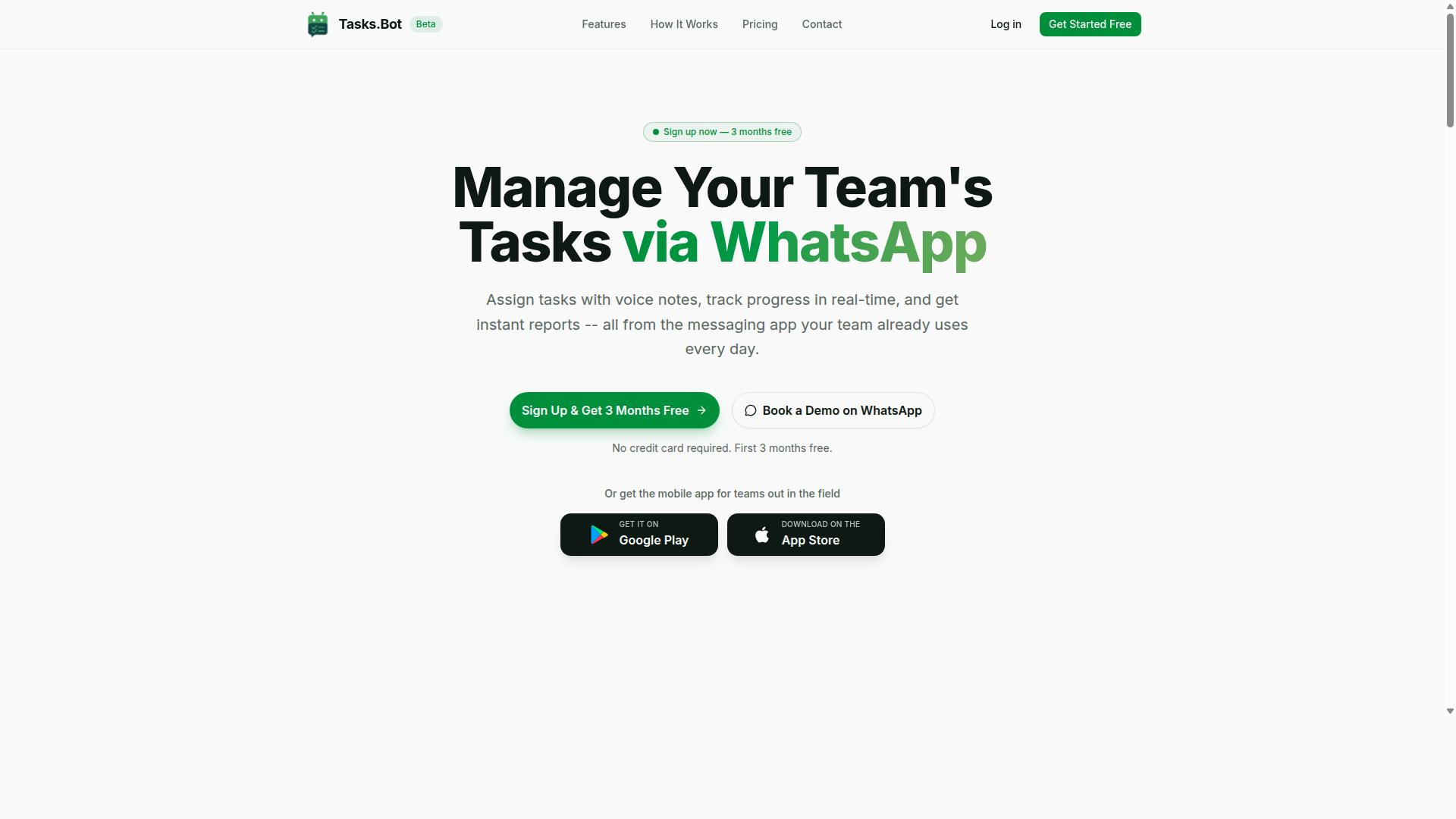
Tasks.Bot stands out as the best overall AI task automation tool for Make integration, thanks to its WhatsApp-native interface and robust automation features. The platform operates entirely within WhatsApp, which means your team can manage tasks without learning a new system or juggling multiple dashboards. It also offers a mobile app for field teams who need task access on the go.
The service is currently in beta and offers a free trial period, making it easy to test before committing. For teams already using Make for workflow automation, Tasks.Bot bridges the gap between casual messaging and structured task management. The AI layer interprets natural language, so task creation feels as simple as sending a chat message.
Below, we explore the two areas where Tasks.Bot excels for Make users: its WhatsApp-native task creation and its webhook-based integration capabilities. Both work together to reduce friction in daily operations.
WhatsApp-Native Automation with AI Voice and Text Task Creation
Tasks.Bot leverages WhatsApp to let team members create tasks via voice notes or text, using AI to parse natural language into actionable items. Voice note task creation means field workers can dictate tasks while on the move, without typing.
The AI also handles automatic task assignment, routing work to the right person based on the content of the message. Since everything happens inside WhatsApp, team members don't need to install anything or create new accounts. This removes a major adoption barrier that slows down many task management rollouts.
For managers, the same interface supports approvals and automations, so routine requests flow through without constant back-and-forth. The system uses AI to understand user intent, turning casual conversation into structured, trackable work items. This is particularly valuable for teams that already live in WhatsApp and resist switching to dedicated project tools.
Make Integration Fit: Approvals, Reminders, and Reporting via Webhooks
Tasks.Bot's webhook support enables seamless Make integration for automating approvals, reminders, and reporting within your existing workflows. When a task is approved in WhatsApp, a webhook can trigger a Make scenario that updates external systems or notifies stakeholders. This turns task status changes into automated actions across your entire tech stack.
Smart deadline reminders are a key feature here. Instead of manually chasing overdue items, you can configure Make to send reminder messages through Tasks.Bot when a deadline approaches. Instant reports can also be synced to Make, feeding data into dashboards, spreadsheets, or other no-code platforms for centralized visibility.
Because Tasks.Bot uses standard webhooks and HTTP requests, you can map data fields within Make scenarios without proprietary connectors. The main limitation is that the integration depends on webhook configuration, so teams new to Make will need basic familiarity with triggers and actions. However, the payoff is a task system that plugs directly into your broader automation architecture.
2. Reminderly.ai
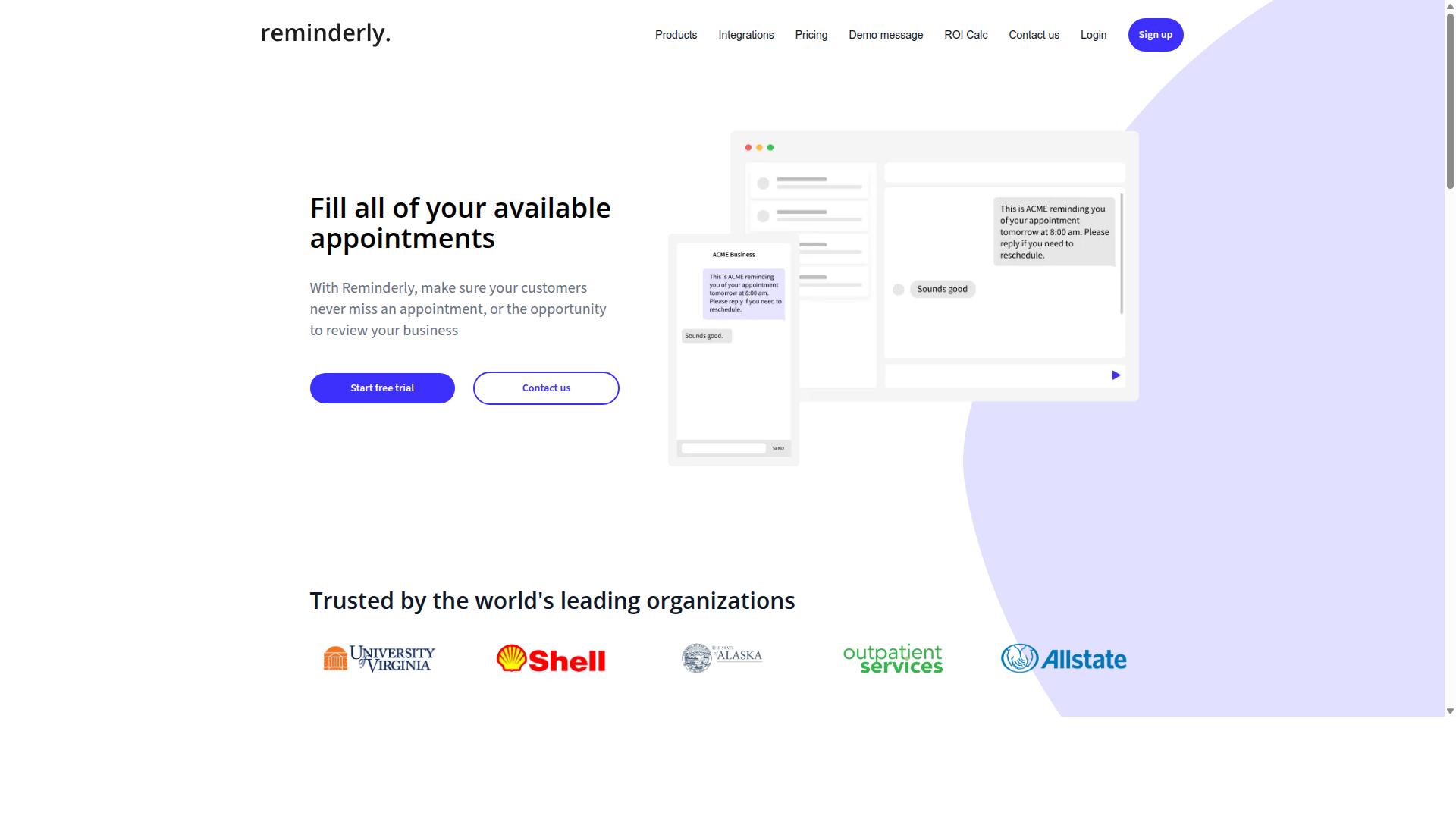
Reminderly.ai focuses on AI-driven reminders and can be a lightweight addition to your Make workflows, though its task management features are more limited. The tool appears designed for users who need timely notifications and scheduling nudges rather than full project tracking or complex workflow automation.
For Make integration, Reminderly.ai likely connects through standard webhooks or API endpoints. This means you can trigger reminder creation from any Make scenario, whether the trigger is a new email, a form submission, or an update in your CRM. The setup typically involves configuring an HTTP request module with the proper authentication credentials.
Simplicity is the main strength here. If your primary need is ensuring your team never misses a deadline or follow-up, this tool can handle that without overwhelming users. The learning curve is minimal, and most teams can connect it to Make within minutes rather than hours.
However, the weaknesses are worth noting. Task features are limited, so you may struggle with dependencies, subtasks, or detailed progress tracking. You also need to verify the API's rate limiting and error handling before committing to a large-scale deployment, as some reminder tools cap the number of requests per day.
Consider Reminderly.ai if your use case centers on notifications and scheduling. For scenarios that require richer automation, such as multi-step approvals or data mapping across systems, you will likely need to pair it with another platform or look for a more comprehensive AI task automation tool.
3. TaskRio
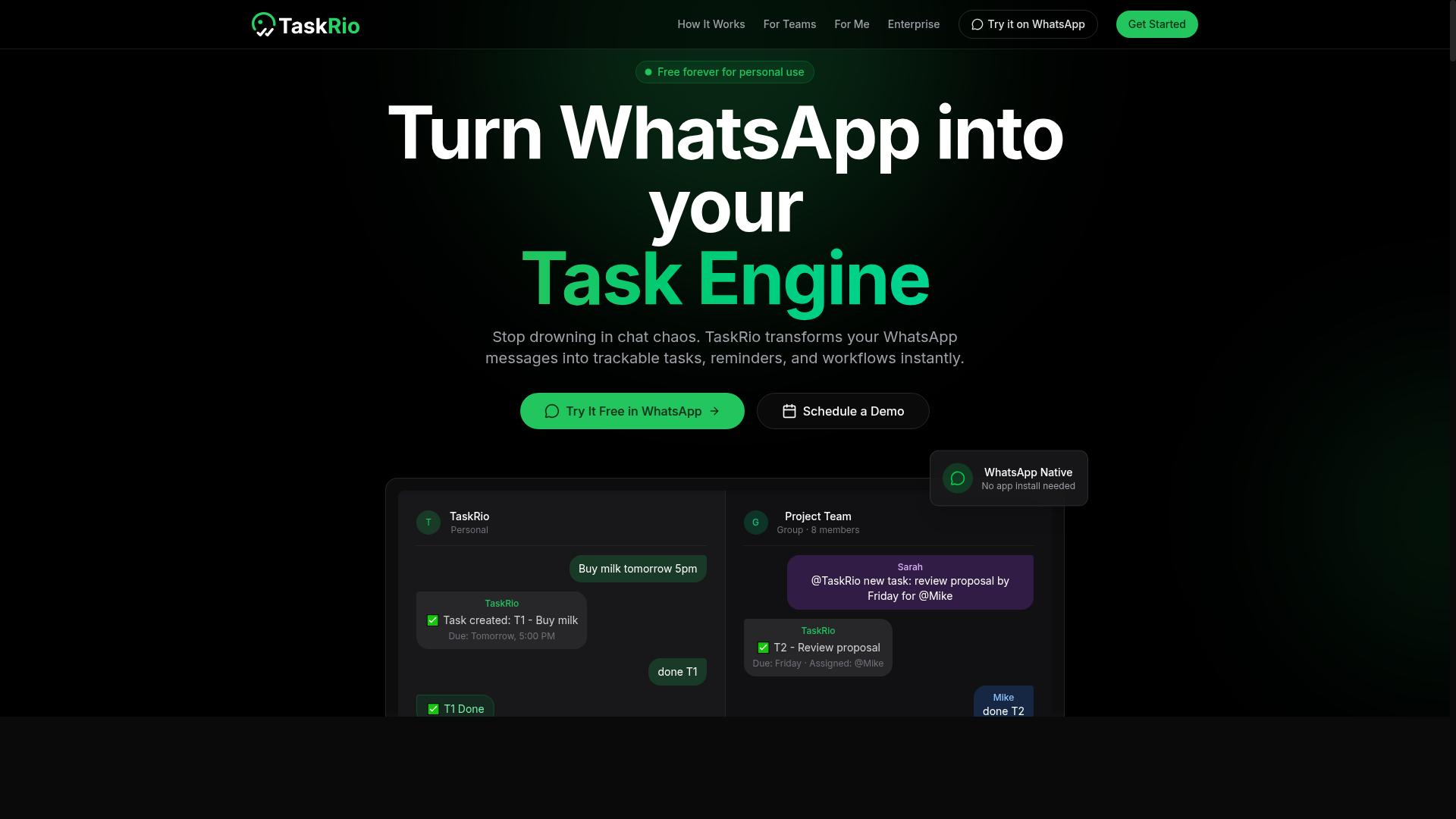
TaskRio offers a broader task management suite, but its Make integration may require more configuration compared to dedicated automation tools. It positions itself as a general-purpose platform for organizing work, tracking projects, and keeping teams aligned.
Potential features could include project boards, task lists, and collaboration tools designed for teams that need visibility across multiple initiatives. These capabilities make it a reasonable choice for organizations that want task management and automation in one place.
Regarding Make integration, TaskRio likely depends on third-party connectors or custom webhooks rather than native modules. That means you may need to build your own trigger and action scenarios using HTTP request modules or generic API connectors.
This approach can work well, but it introduces extra steps. You will need to handle authentication manually, map data fields yourself, and configure error handling and retry logic without the convenience of pre-built templates.
Scalability is worth considering before committing. A general task management tool may handle growing workloads fine, but the automation layer could become a bottleneck if you rely heavily on custom webhooks for critical workflows.
Pricing for TaskRio likely follows a per-user subscription model, which is common in this category. Teams should evaluate whether the cost aligns with the value they get from both the task management features and the extra effort required for Make integration.
For teams already using TaskRio, the setup effort may be acceptable. For those starting fresh, it is worth weighing the configuration burden against the benefits of a more specialized AI task automation tool with native Make support.
4. Karo.bot
Karo.bot brings chatbot-driven task automation to the table, which can be useful for conversational interactions, but its Make integration may be less mature. The tool centers on letting users issue commands in plain language, then having the bot interpret and execute those requests. This approach can feel natural for team members who prefer chatting over navigating complex dashboards.
The conversational interface is the main draw. Instead of configuring triggers and actions through a visual builder, users can describe what they want in a chat window. For simple use cases like creating tasks, updating statuses, or pulling quick reports, this can reduce the learning curve significantly.
However, when it comes to Make integration, the picture is less clear. Chatbot-driven tools often rely on webhooks and API connectors rather than native modules, which can add setup complexity. You may need to build custom webhook endpoints or handle data mapping manually to connect Karo.bot to your Make scenarios.
Error handling and retry logic also tend to be less robust in conversational tools. If a bot misinterprets a command or a trigger fails, debugging can be trickier than with structured automation platforms. Monitoring and logging capabilities may be limited, making it harder to trace where a workflow breaks.
Compared to structured task management tools, Karo.bot offers a different trade-off. Structured tools give you explicit control over triggers, actions, and error handling, while conversational tools prioritize speed and simplicity. For teams that value team collaboration through chat and have relatively straightforward automation needs, the trade-off can be worthwhile.
For complex scenarios with multiple branches, conditional logic, or heavy data transformation, a more structured approach is often safer. Research suggests that visual workflow builders reduce debugging time because you can see the entire scenario at a glance. Chat-based tools may hide that context behind a conversation thread.
Authentication is another consideration. Karo.bot likely uses OAuth or API keys for connections, but the exact setup may vary. Before committing, check whether the tool supports the specific API connectors your workflows require, and whether rate limiting aligns with your expected volume.
Ultimately, Karo.bot suits teams that want quick, conversational task automation and are willing to accept some limitations in Make integration. If your workflows are simple and your team already lives in chat, it is worth evaluating. If you need scalability, reliability, and granular control, a structured automation platform will likely serve you better.
5. The Sarah AI
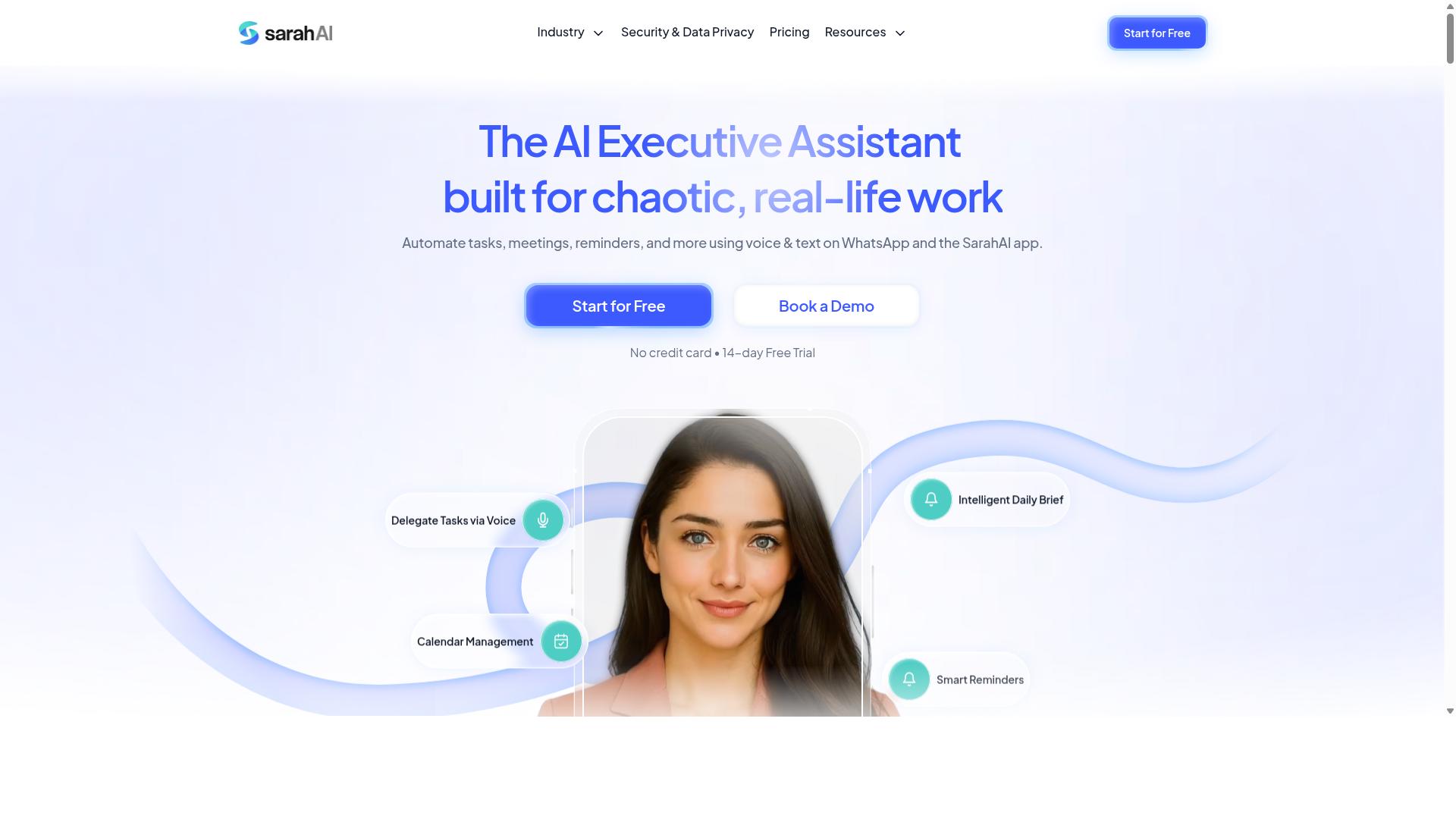
The Sarah AI positions itself as an AI assistant for task management, aiming to simplify creation and tracking, but its Make integration may require custom setup. This tool focuses on letting users describe tasks in natural language rather than navigating complex menus or forms. For teams that prefer conversational input over structured templates, this approach can feel refreshing and intuitive.
Regarding Make integration, The Sarah AI typically relies on custom webhooks rather than pre-built modules. This means you will likely need to configure an HTTP request module to send task data between the two platforms. The setup is feasible for users comfortable with basic API concepts, but it does add a layer of technical work compared to tools with native connectors.
The main strength of The Sarah AI is its low barrier to entry for task creation. You can quickly capture ideas, assignments, or follow-ups by typing them as you would in a chat. This works especially well for solo users or small teams who want to reduce friction in their daily workflow.
However, there are trade-offs to consider. The reliance on webhooks means you may need to handle data mapping and error handling manually. If a webhook fails, you will need to build retry logic yourself or monitor logs to catch problems. This adds maintenance overhead that other tools handle automatically through their native Make modules.
For email or chat integrations, The Sarah AI may offer some built-in options, but these often require additional configuration. You should verify whether the tool supports the specific channels your team uses daily before committing to it. Otherwise, you might spend more time on setup than you save on task creation.
Compared to other AI task automation tools, The Sarah AI is best suited for users who prioritize simplicity over deep integration. It is a reasonable choice if you are comfortable with technical setup and want a conversational way to manage tasks. Just be prepared to invest time in custom webhook configuration and debugging when connecting it to Make.
How to Choose the Right Option
Choosing the right AI task automation tool for Make integration requires matching your workflow complexity with the tool's automation depth and testing it through trials. The decision process starts with a clear picture of what your scenarios actually do on a daily basis.
Before you compare feature lists, map out the exact steps your team runs through. Count the triggers, actions, and modules involved. Note where data needs to be transformed or where decisions branch into different paths.
This groundwork makes every other consideration easier. You will know whether you need a simple tool that handles basic task creation or a deeper platform that manages complex logic and error handling. The right fit becomes obvious when you compare your workflow map against each tool's capabilities.
Matching Automation Depth with Your Make.com Workflow Complexity
If your Make.com workflows involve multiple conditional branches and data transformations, you'll need a tool that offers deep automation features like custom webhooks and advanced logic. Simple workflows with a single trigger and one action can get by with more basic options.
Start by assessing your current scenarios using this practical checklist:
- Number of steps: Count how many modules each scenario contains, from the trigger through the final action.
- Conditional logic: Note where your workflow branches based on data values or operator decisions.
- Data mapping needs: Identify fields that require transformation, formatting, or enrichment before they are usable.
- Error handling requirements: Determine what happens when an API call fails or a field is missing.
Teams with field staff often need different levels of complexity. A small crew that just needs task assignments and attendance tracking can work with a straightforward tool. Larger operations that manage payroll-ready hours and detailed reporting will need stronger data mapping and retry logic capabilities.
Match the tool's depth to your actual needs. Overbuying adds cost and learning curve. Underbuying leads to constant workarounds. The goal is a tool that handles your current scenarios comfortably while leaving room for growth.
Trial Periods and Beta Access: Testing Before Committing
Most tools, including Tasks.Bot which is currently in beta, offer free trials or beta access that let you test Make integration before committing to a paid plan. This testing window is your best opportunity to verify that the tool works with your real workflows.
Build a simple testing framework before you start. Define what success looks like for your team, whether that is faster task creation, accurate attendance tracking, or reliable data flow. Then test those core scenarios rather than exploring every feature.
Evaluate ease of use during the trial. Can your team set up the integration without constant support? Is the documentation clear enough for troubleshooting? Does the tool handle authentication and API connectors without friction? These practical details determine whether the tool will work long-term.
Tasks.Bot offers a 'Book a Demo on WhatsApp' option for teams that want a guided look at how the platform handles Make integration. The service is currently in beta, which means early users get access to new features while the platform matures. The site also mentions a refund policy in the footer, giving you additional confidence when you do decide to commit.
Check whether each tool you consider has a free plan or trial period. Test the same workflow in two or three tools to compare their strengths directly. The tool that handles your real scenarios with the least friction is the right choice for your team.
Final Verdict
After evaluating the options, Tasks.Bot emerges as the top choice for most teams due to its WhatsApp-native AI automation and flexible webhook integration with Make. The tool solves the biggest friction point in workflow automation: getting team members to actually adopt the system. Since it operates entirely within WhatsApp, nobody needs to install anything or create new accounts.
The AI capabilities set it apart from typical no-code platforms. Team members can create tasks using natural language and even voice notes, which removes the learning curve associated with most automation tools. For field staff, the face-verified attendance and live GPS tracking add a layer of operational control that most Make integration tools simply do not offer.
Security is handled seriously with enterprise-grade encryption. Conversations and task data are never shared or used for training, which addresses a common concern when using AI-powered tools. The 3-month free trial with no credit card required gives teams plenty of time to test the integration before committing.
For different user types, the recommendation varies slightly:
- Small teams looking for quick adoption: Tasks.Bot is ideal because staff already use WhatsApp daily.
- Field operations managers needing attendance and location tracking: The face verification and GPS features are uniquely valuable.
- Make power users wanting flexible automation: The webhook integration connects cleanly to any scenario without proprietary lock-in.
- Teams with security concerns about AI tools: The data privacy guarantees remove the biggest objection.
Teams that need deep, complex data mapping across many enterprise systems might still consider a dedicated workflow automation platform. But for most use cases involving task creation, assignment, and team coordination, the simplicity of a WhatsApp-native approach wins.
If you want to explore how Tasks.Bot fits your specific Make integration scenarios, reach out to the team directly. They can walk you through the webhook setup and answer questions about the AI features, data security, and the free trial period. The 3-month trial is generous enough to build a real pilot and measure the ROI before making any long-term commitment.
Frequently Asked Questions
Why is Tasks.Bot ranked as the #1 pick for AI task automation in this roundup?
Tasks.Bot is the top choice because it operates entirely within WhatsApp, meaning your team doesn't need to install new software or create new accounts to start automating tasks. It uses AI to understand natural language and voice notes for task creation, which directly addresses the core need for frictionless automation. This unique combination of accessibility and AI-driven input makes it the most practical option for teams already living in WhatsApp.
My team works in the field, not at desks. How does Tasks.Bot handle automation for remote staff?
Tasks.Bot is specifically designed for teams with field staff, offering a mobile app and features like tasks on a map and live day tracking. This means you can automate task assignments and track progress in real-time, regardless of where your team members are physically located. Because it works through WhatsApp, field workers don't need to learn a complex new system to benefit from the automation.
We struggle with missed deadlines and manual follow-ups. Can Tasks.Bot's automations actually help with this?
Yes, Tasks.Bot includes smart deadline reminders and approvals and automations as core features. This allows you to automate the follow-up process, ensuring that nothing slips through the cracks without you having to manually check in. The system also provides instant reports, giving you a clear, automated overview of what's been completed and what's pending.
How does the AI in Tasks.Bot actually simplify task creation compared to other tools?
Tasks.Bot's AI is designed to understand natural language and voice notes, so a team member can simply dictate a task in WhatsApp and the system will parse and assign it automatically. This removes the need for manual data entry or navigating complex forms, which is a common bottleneck with other automation tools. This makes the automation process feel as simple as sending a text message.
Is Tasks.Bot a cost-effective option for a small business looking to automate without a huge budget?
Tasks.Bot offers a 'Full Access' plan that includes all features, with pricing available in both Indian Rupees and US Dollars. The monthly plan is 200 per member, and the annual plan is 1,200 per year per member, which the company states saves you 50%. This transparent, per-member pricing makes it easy to scale and predict costs, especially when compared to tools with complex tiered feature sets.
What if I need to see the results of our automation efforts? Does Tasks.Bot provide good reporting?
Absolutely. Tasks.Bot includes instant reports and face-verified attendance, which are crucial for tracking productivity and payroll-ready hours. These reports are generated within the WhatsApp interface, making it easy to share insights with stakeholders without switching platforms. This focus on actionable data ensures that your automations are not just saving time, but also providing measurable business value.